
.avif)


Please provide your contact information, and we'll get back to you shortly.
Thank you!
We'll get back to you about this within a few business days.
Oops! Something went wrong while submitting the form.


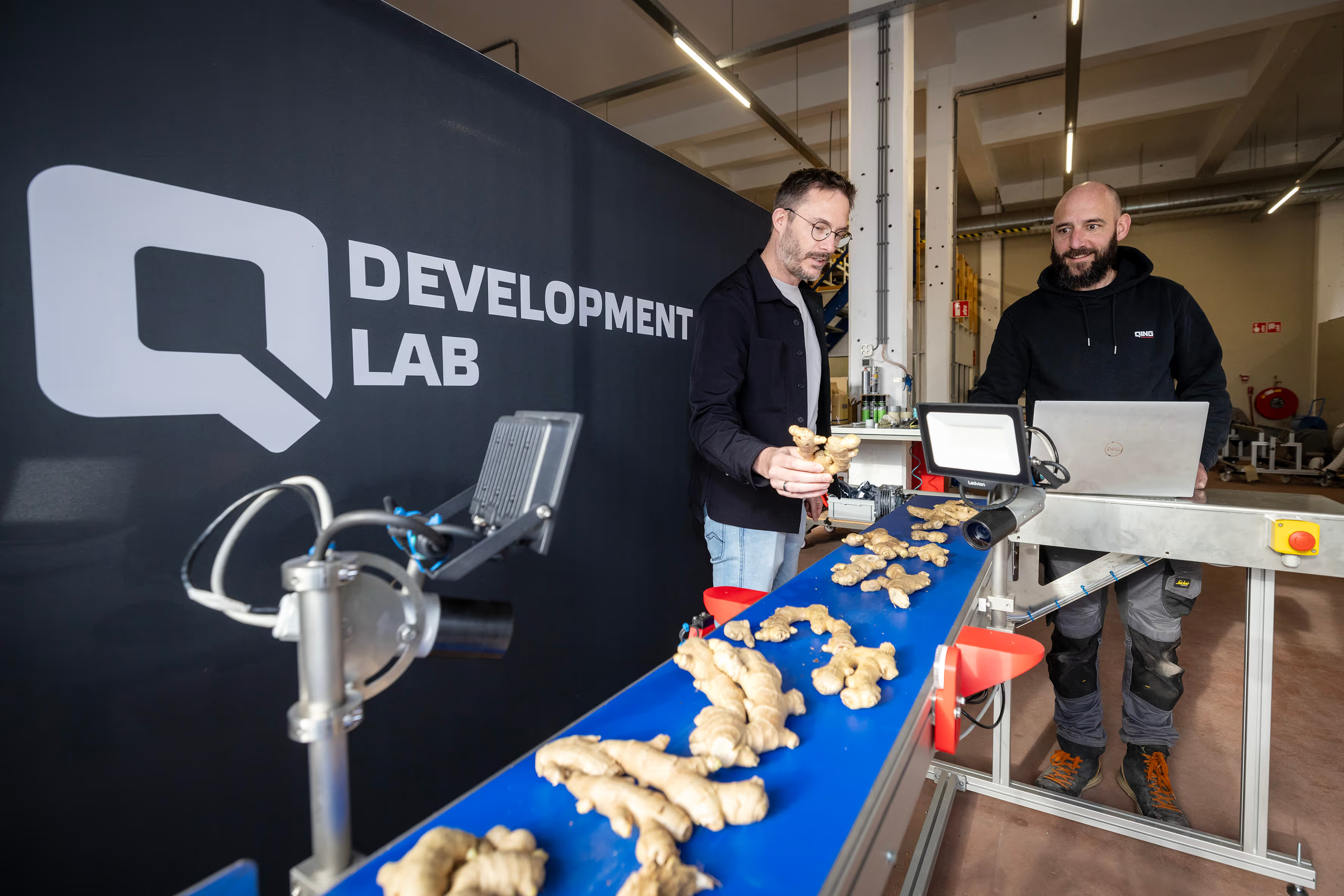
To become a world player in automation in the agrifood sector. That's the crystal clear ambition of difference maker Bram de Vrught, who won a spot in the 2024 Food100 as a food innovator. As director of QING, he and his team turn the considerable challenges in the food industry into opportunities for growth. In addition to technology and creativity, he says this requires a hefty dose of curiosity. "From curiosity, the best ideas arise," he says.
Source : https://www.agrifoodcapital.nl/nl/verschilmakers/bram-de-vrught-maakt-technologie-toegankelijk-voor-de-voedselindustrie/
More or less by accident, Bram ended up in the food industry. After studying Mechanical Engineering and Automotive, he worked as an R&D engineer at various companies. A born techie, in other words. "At some point I started thinking about what I really wanted. I loved innovation. That's how I ended up at a small engineering company in Duiven. Two weeks after I started there, the founders of QING took over. After all the corporate stuff, they wanted to build a company that really works from people. For me, it was a fantastic journey to work with these four men to shape the company. Without them, I probably would not have ended up in this position and the agrifood sector."
Bram is now co-owner and director of the company with over forty employees. They focus on two of the biggest challenges in the food industry: staff shortages and the energy transition. With a focus on innovative solutions for food processing. "We want to make an impact with our company," says Bram. "From a technology perspective, that is quite difficult. Where do you do that and especially how? There are so many technological challenges in the food chain that can have a visible and measurable impact. This involves the integration of different technologies, so for example robots combined with AI or data. We saw that relatively few companies look at this in this holistic way. And also that they often don't ask themselves how that technology can land in their organization. It is precisely those challenges that we bite into."
The QINGs, as the employees are called, are idiosyncratic in their approach. For them, automation is not simply a matter of building machines to take over work, but a process of really understanding where the customer's needs lie. So no standard solutions, but customization. "We often get the question: can you automate this process? Instead of going straight to work, we ask further," says Bram. "We want to understand why something is important, how a process works and where the actual value lies. Verbruggen Paddenstoelen in Erp, Brabant, for example, wanted to automate the sorting of oyster mushrooms. That was done manually by people on the assembly line, but they are increasingly difficult to find. So we asked: why is that sorting so important? How is the value of those mushrooms determined?"
'Only when we understand the whole picture can we come up with a good solution'
QING's approach shifts the perspective from automation as cost savings to automation as value creation. With the use of AI, the Erp entrepreneur can gain much more control over his product and process. It was no longer just about replacing scarce labor, but mainly about increasing revenue by being smarter with the product. Bram: "That is where we make the difference: supplying the technology and using our curious and idiosyncratic approach to help apply it optimally in practice. We challenge everything we do. Only when we understand the whole picture can we come up with a good solution that has much more impact than just that piece of automation."
Yet many companies are still reluctant to adopt new technologies. Applying AI and robotization is new to them and the investments are not small. The question is also whether they will work. "We try to remove these kinds of doubts by taking a step-by-step approach based on a number of tests," Bram explains. "We only offer a full automation system once we have successfully completed all the steps. In this way we lower the threshold for investment and make technological developments more accessible. We do this together with Next Tech Food Factories, the program office of AgriFood Capital and Brainport Development that stimulates the application of more smart technologies in the food processing industry. QING is actively involved in the development of a network of test and validation sites within this collaboration. Food companies, machine builders and high-tech suppliers test their innovations with us to increase the chances of success."
What is the strength of the collaboration? "It is in the reciprocity," says Bram. "Look, we obviously have enormous ambition as well as the knowledge, facilities and technology to make an impact in the agrifood sector. AgriFood Capital and Next Tech Food Factories have a gigantic network, also internationally. During the World Food Forum in Rome last October, we jointly put the role of food processing in the food system on the map. This was an underexposed topic and has now been embraced. Without those two parties, we would never have had a stage there. So it's a very nice interaction. If we want the Netherlands to maintain a competitive position in food in the world, we need to nurture and strengthen these kinds of collaborations. I firmly believe in that."
QING is increasingly gaining a foothold in Northeast Brabant. No surprise when you consider that this is the top region in agrifood thanks to the complete ecosystem and short lines of communication between the parties. For example, QING is also involved in The Chocolate Factory on the Noordkade in Veghel. Here, education and business will work together on the food chains of the future. Bram and his team developed a sprinkles machine, which allows young people to put together their own pack of sprinkles, including a robot that picks up the process. "It was immediately clear to us that we wanted to be there: the initiative combines food, technology and social impact. And as a technology company, we think it's important to get more people into technology. Over the next five years, together with The Chocolate Factory, students from the Koning Willem I College, among others, and other stakeholders, we will be setting up projects to develop new technologies. We already have an office on the Noordkade. In January we will move to the factory itself."
'The most important skill someone needs is to be able to deal with change'
According to Bram, the new generation of engineers and other food changers need to embrace change. For students at the HAN University of Applied Sciences, he recently gave a presentation on change. To reinforce his story, he asked ChatGPT about the similarities between an agile (agile) approach to innovation and life. The answer: they share similarities in adaptability, continuous improvement, flexibility, collaboration, goal-setting, time management and embracing uncertainty. Bram: "The most important skill a person needs is to be able to deal with change, because the world is changing at such a tremendous pace. Therefore, we need to come up with solutions that not only solve the problem of now, but are also flexible for the problems to come."
"Innovation never goes without traps. If you are ahead, you always have to be the first to overcome hurdles. But with the right mindset and flexibility, any ambition is achievable. This is not about a tight time frame, but about your ambition. AND about flexibility to deal with change."


Bram will be happy to help you.