



Laat je gegevens achter en dan nemen we snel contact met je op.
Bedankt!
Wij komen hier binnen enkele werkdagen bij je op terug.
Oops! Something went wrong while submitting the form.


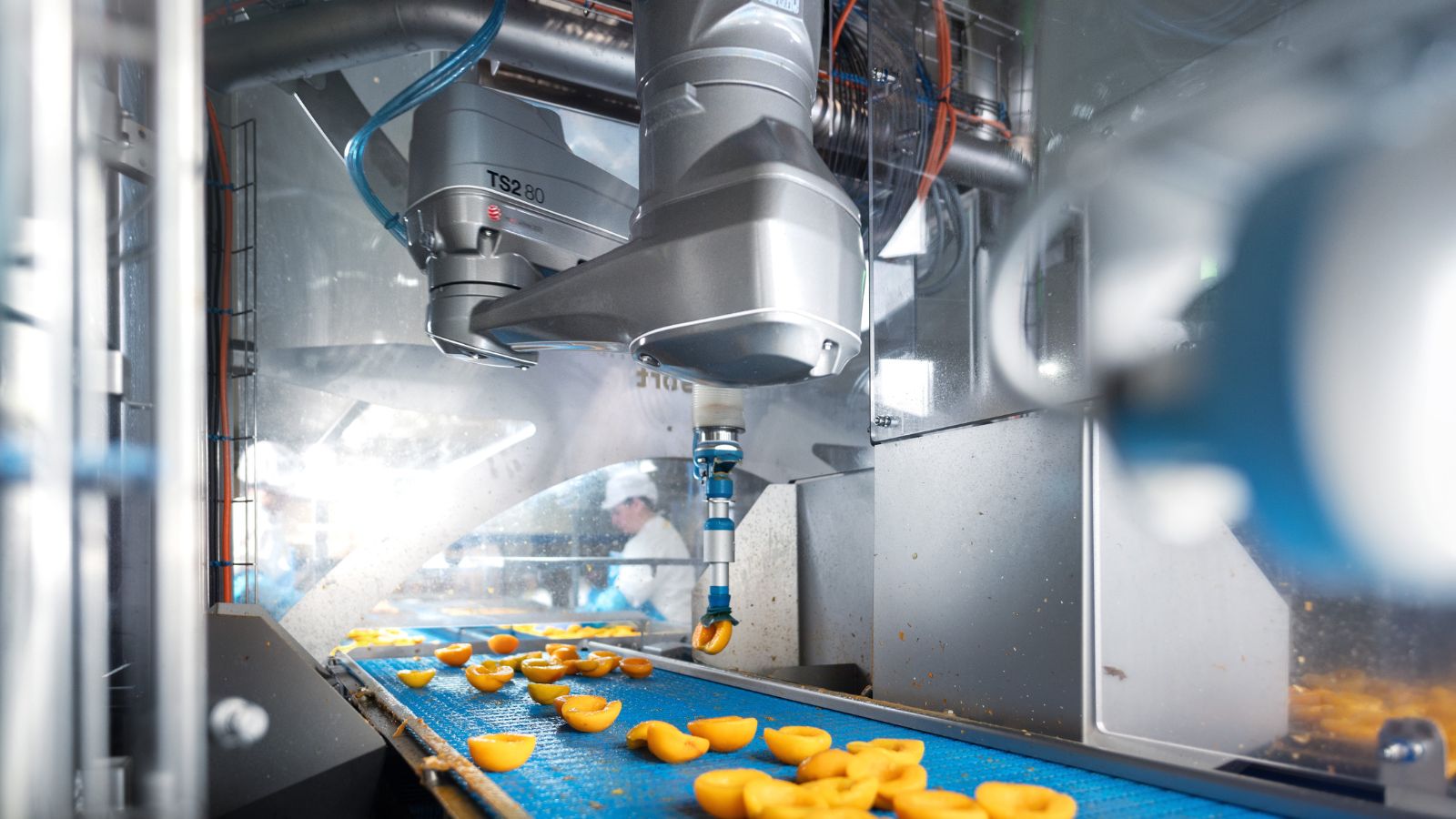
At the Agrophoenix fruit processing plant in Greece, an automated AI- and vision-based inspection system grades peach halves at remarkable speed: During the season, 15 tons of peaches are processed per hour, about 200,000 peaches, each cut in half. The vision system sees them all, and eight Stäubli SCARA robots pick out the bad ones, each at a rate of up to one per second.
Are there any pit fragments in a fresh peach half processed at the Agrophoenix plant? This question is answered by an automated vision and picking system operating with high performance and precision. Hygienic Stäubli SCARA robots are integrated into the AI- and vision-based STAQ inspection system, developed by Dutch startup QING.
Creating something new and fresh: Agrophoenix was founded on this idea in 2018. Since then, the company has found new ways to process fruit like apricots, apples, peaches, and pears. It has also developed new fruit-based convenience foods and advanced automation across the entire process, from peeling to packaging.
A prime example of automation at Agrophoenix is the inspection of peeled and depitted peach halves. Residual pit materials, whether whole pits or small fragments, must be detected and removed. Agrophoenix sought an automation solution for this task, knowing that handling the soft, moist peach halves would be a challenge. The second challenge was the sheer amount of fruit: In the harvest season, the company processes up to 100,000 peaches per hour, meaning that 200,000 peach halves (3,333 per minute) must be inspected, and up to 480 can be rejected.
Agrophoenix partnered with Dutch startup QING, the developer of an AI- and vision-based inspection system specifically for the food industry called STAQ – an acronym based on the principle “See, Think, Act.”
Each STAQ system consists of a camera or vision sensor and a Stäubli TS2-80 SCARA robot in the HE (humid environment) version, both contained in a very compact cell. Precision and durability played a role in selecting the robot, as did its connectivity to the control system and, of course, hygienic compliance. The TS2-80 HE offers washdown capabilities: The joints are IP67 protected, all materials are corrosion-resistant, and an inner pressure prevents vapor, steam or water from entering the housing during cleaning. Because the robots are top-mounted over the conveyors, QING opted for a filling of H1 oil.
Eight parallel lines were installed to handle high processing volumes. In each of the eight cells, the vision system detects two types of N.I.O. peach halves – those with whole pits and those with smaller pit fragments – which the robot picks and places on one of two different conveyors. The vacuum gripper is able to grip the moist, slippery peach halves with their cups upside down.
The STAQ systems were put into operation just before the start of the peach harvest season in 2025.
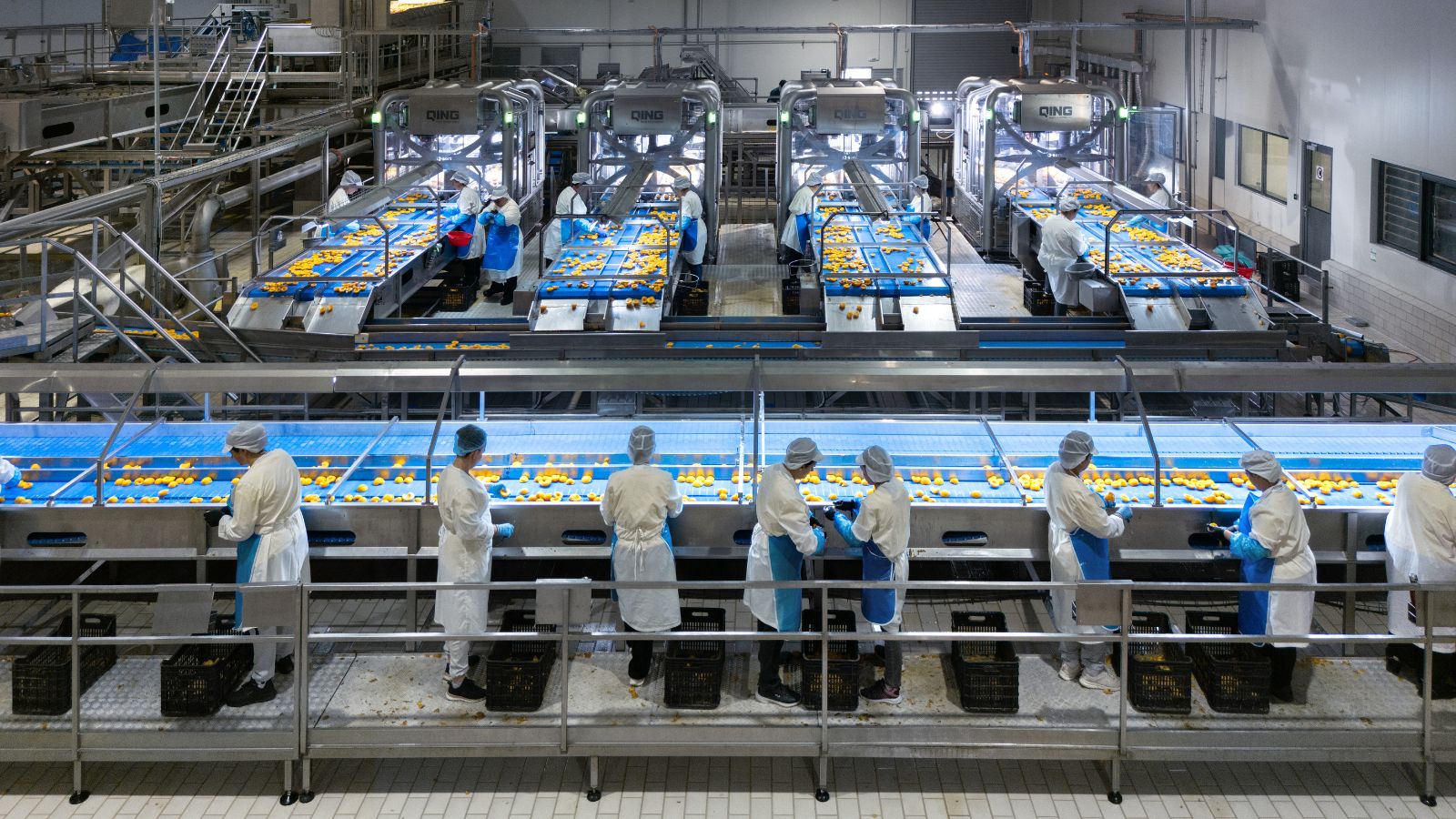
With the new inspection system designed and manufactured by QING, Agrophoenix is now able to automate a core step of peach processing. At the same time, the highest quality is guaranteed: No matter how many peaches are re-routed for further processing, pits and pit fragments are not an issue. This is what matters most to Agrophoenix customers and consumers. Using cameras rather than the human eye to inspect the peaches ensures consistent quality, and due to the hygienic design of the robots and cells, the risk of contamination is eliminated.
Source: https://www.staubli.com/global/en/robotics/industries/food/fruits-and-vegetables/automated-quality-inspection-of-fresh-fruit


Will helpt je graag verder