



Laat je gegevens achter en dan nemen we snel contact met je op.
Bedankt!
Wij komen hier binnen enkele werkdagen bij je op terug.
Oops! Something went wrong while submitting the form.


While automated quality control is standard in mechanical engineering, the situation is different in the food industry. No two products are the same, and hygiene standards make automation even more challenging. Nevertheless, one baked goods manufacturer has succeeded in automating the inspection of its products using AI and pioneering robotics.
AI-supported, robot-assisted quality inspection of baked goods
Bolletje, a Dutch baked goods manufacturer, has automated its quality inspection. An inspection cell consisting of a camera system and four-axis robot enables the inspection of up to 1,200 rusk slices per minute. The image data is analyzed with the help of AI and used for system optimization. A Stäubli TS2-80 SCARA sorts out defective products.
How do you check the quality of 1,200 slices of rusk as they leave a 200-meter-long oven line every minute? A team of five employees is deployed to sort out non-conforming products, such as overly browned slices, with a trained eye and quick reactions. This is how Bolletje in Almelo, the Netherlands, operated for many years.
Investment in AI-supported quality control
Today, things look different: A compact robot cell consisting of a camera, a four-axis Stäubli robot, and an AI-based IT platform takes on the task. The rusk slices are captured by a camera, the image data is analyzed within milliseconds, and the products classified as “non-conforming” are sorted by the Stäubli robot.
The data from the 100% inspection is comprehensively evaluated. Lo Huls, COO of Bolletje: “We record the type of deviation and correlate it to the system data. This task is performed by our data analytics tool, which monitors all ovens and other process steps. This enables us to identify the causes of quality defects and initiate targeted countermeasures.”
Bram de Vrught, Managing Director of systems integrator QING Food Automation, describes the practical implementation of this process: “The system records the images, transfers them to the STAQ platform, and classifies the products and various defect patterns. We can then train the AI based on this classification. Overall, the system is very user-friendly, allowing companies to deploy it independently and extend the technology to other products or new quality criteria.”
Right from the start of STAQ's development, QING relied on four-axis robots from Stäubli. A delta robot would have required more installation space, increasing the cell’s overall footprint. Under these conditions, the highly dynamic Stäubli TS2-80 delivers the best performance.
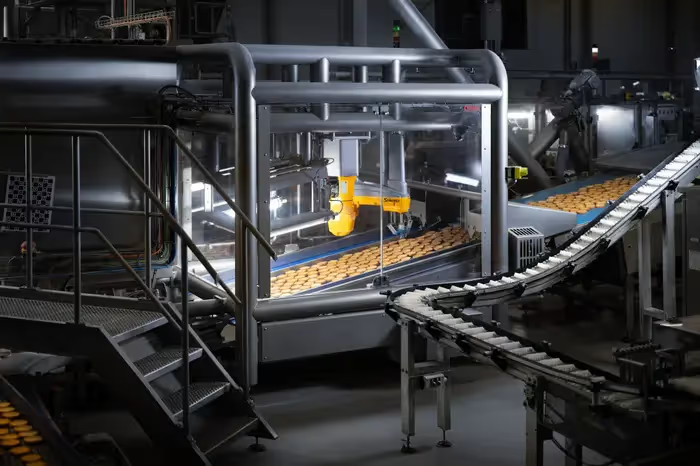
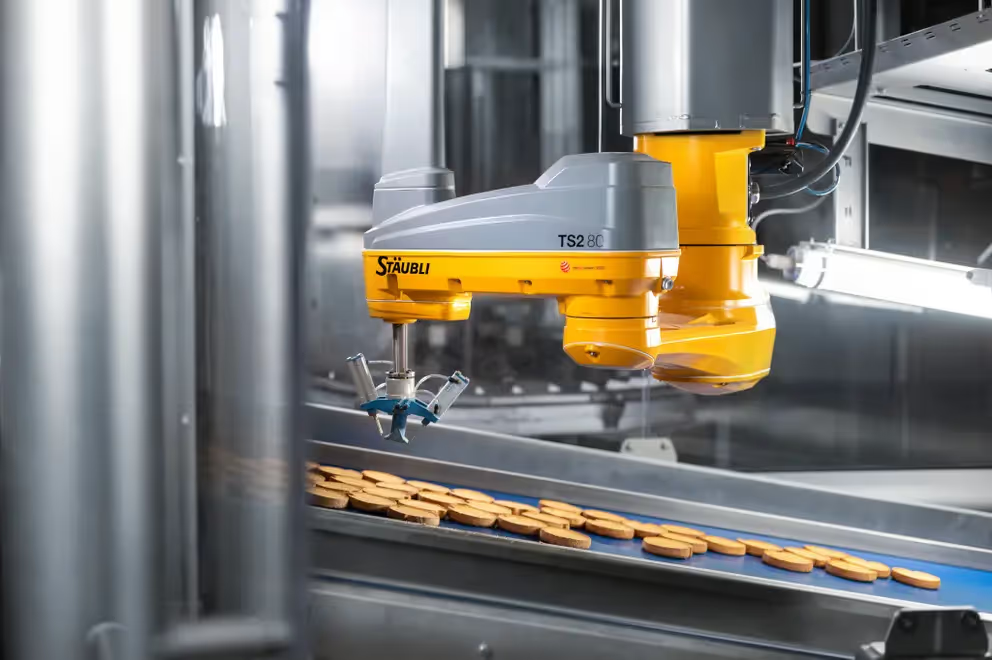
Automation has enabled the five Bolletje employees who were previously responsible for visually inspecting 1,000 to 1,200 rusks per minute on this line to take on other tasks in the industrial bakery.
The use of Stäubli’s VALtrack software also proved to be particularly advantageous. It synchronizes the robot’s movements with the conveyor belt’s, meeting an essential prerequisite for fast and precise gripping of the products being sorted.
“We could have implemented a system with two robots. However, this would have nearly doubled the costs and space requirements, and due to coordinating the robots, the programming effort would have increased significantly. Therefore, a robot optimized for peak performance is the more economically sensible approach. The TS2-80 continues to operate in the green range, i.e., within its design limits, so we expect a long service life and minimal service requirements even in 24/7 operation.”
says Bram de Vrught, Managing Director of systems integrator QING Food Automation


Will helpt je graag verder