

Please provide your contact information, and we'll get back to you shortly.
Thank you!
We'll get back to you about this within a few business days.
Oops! Something went wrong while submitting the form.


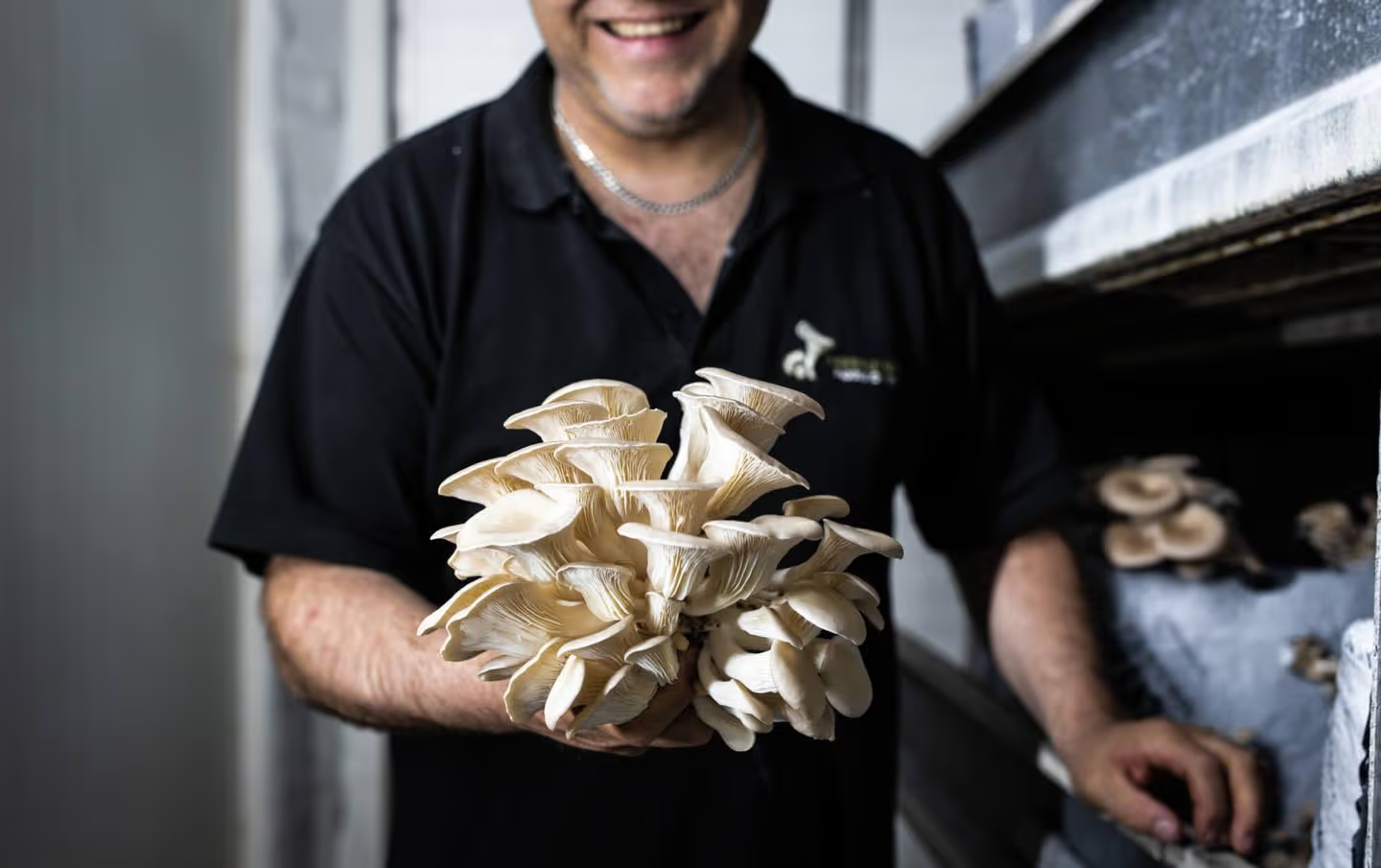

The need for innovation in agriculture is greater than ever. Climate targets, less agricultural land and changing consumer demand mean that major efficiency gains are necessary. This calls for courage, daring and a powerful vision of the future. The mushroom sector has been leading the way in this field for more than 40 years. The raw materials are residual streams from agriculture and cultivation takes place in climate-controlled cells. This is also known as 'vertical farming'. In line with this development, Verbruggen Paddestoelen is investigating the application of deep learning in oyster mushrooms.
Proof of concept
Machine vision and deep learning
Data analysis
With over 40 years of experience, Verbruggen Paddestoelen is a leading organic oyster mushroom grower at home and abroad. Thanks to the large increase in the demand for meat substitutes, the oyster mushroom has grown considerably in popularity in recent years. Due to its firm and fleshy structure, this organic product is extremely suitable as a high-quality raw material for meat substitutes. Think of vegetarian hamburgers, croquettes and meatballs.
To continue to meet the growing demand, Verbruggen Paddestoelen is looking ahead. Harvesting, packing and sorting of oyster mushrooms involves a lot of manual work. In the future it will be increasingly difficult to find suitable personnel, which is why the demand has arisen to carry out the current production process of oyster mushrooms even more efficiently. The oyster mushroom grower is always looking to adapt the latest technologies in its production process. Therefore, the company continues to innovate and has the desire to automatethe sorting and packaging process in a first step.
In the search for an innovative partner, the oyster mushroom grower turned to QING. QING offers its clients access to technological knowledge and innovative strength in the agri, food and packaging market. Together with Verbruggen Paddestoelen we investigated whether it would be possible to analyse oyster mushrooms with image processing and how reliable it would be. The results of this research have provided important insights into the application of this technology to extract more value from oyster mushrooms. This project was partly realised with support from the 'Stuurgroep Landbouw Innnovatie Brabant' (LIB).
After harvesting, the oyster mushrooms are classified into different quality categories by an operator, where, among others, the size of the cap and the degree of damage are important parameters. Because the grading in the current situation is based on the subjective assessment of the operator, it is difficult to guarantee a consistent grading process. In addition, training new personnel takes up a lot of time. Therefore, Verbruggen asked QING to set up a system that can monitor the oyster mushrooms produced and eventually sort them independently.

The most important parameter during the sorting process of oyster mushrooms is the size of the cap of the oyster mushroom. To be able to determine this, we needed software that is able to distinguish between the cap and the stalk. We took a large amount of pictures of oyster mushrooms to be able to do the first tests. It soon became clear that the use of traditional vision software would be too complex and error prone due to the large variation in shape, colour, contrast and growth direction of the oyster mushroom. The suitable alternative is a deep learning segmentation algorithm.

Deep learning is a technology that uses large amounts of sample data to 'train' a neural network. The algorithm analyses the sample data and looks for patterns in the sample data, so that it can then assess new data in the same way. The deep learning algorithm first had to learn the difference between the hat and the stem. We labelled all 1500 photos and indicated for each photo which part of the photo contained the oyster mushroom's hat. Next, an algorithm was trained with this data. The result is a system that has a deep understanding of what the hat of the oyster mushroom is. It can therefore recognise it flawlessly and subsequently determine its size. Teun Keusters, one of our engineers, explains: "The main problem with traditional vision software is that it is extremely sensitive to changes, because this software only looks at contrast. So, for example, if the ambient light changes, this can have a big impact on the outcome. Also, if the conveyor belt becomes dirty or discoloured over time, this can have a big impact on the performance of the software. With deep learning, the software really develops an understanding of the objects it is looking at and is therefore much less sensitive to these kinds of fluctuations."
This technology determines with higher accuracy what the cap of the oyster mushroom is and in which quality category it should be classified. The technology is easily scalable or retrainable, for example when quality requirements change or when working with a different type of mushroom.


- Particularly suitable for organic products without solid form
- Able to grasp complex patterns and develop an understanding of the relevant product characteristics.
- Easy to retrain in case of changed products or quality requirements
- Relatively insensitive to fluctuations in the set-up, such as a different product shape, a changing light situation or dirt on the conveyor belt.
During the research, the possibilities and impossibilities of conventional image processing and deep learning were discovered for the production process of oyster mushrooms. Both parties gained valuable insights. Both QING and Verbruggen Paddestoelen recognise the potential of this technology to not only optimise labour requirements, but also to minimise waste during the production process.
Thanks to the results of the study, Verbruggen Paddestoelen also gained insight into the size of the investment needed for an automatic packing machine. Based on this information, they will look at how they will roll out this innovation within the company.
Are you also curious about how you can get more value out of your current product flow with the application of image processing and deep learning? Please feel free to contact us.
Teun would be happy to tell you more about Vision AI



.avif)