

Please provide your contact information, and we'll get back to you shortly.
Thank you!
We'll get back to you about this within a few business days.
Oops! Something went wrong while submitting the form.


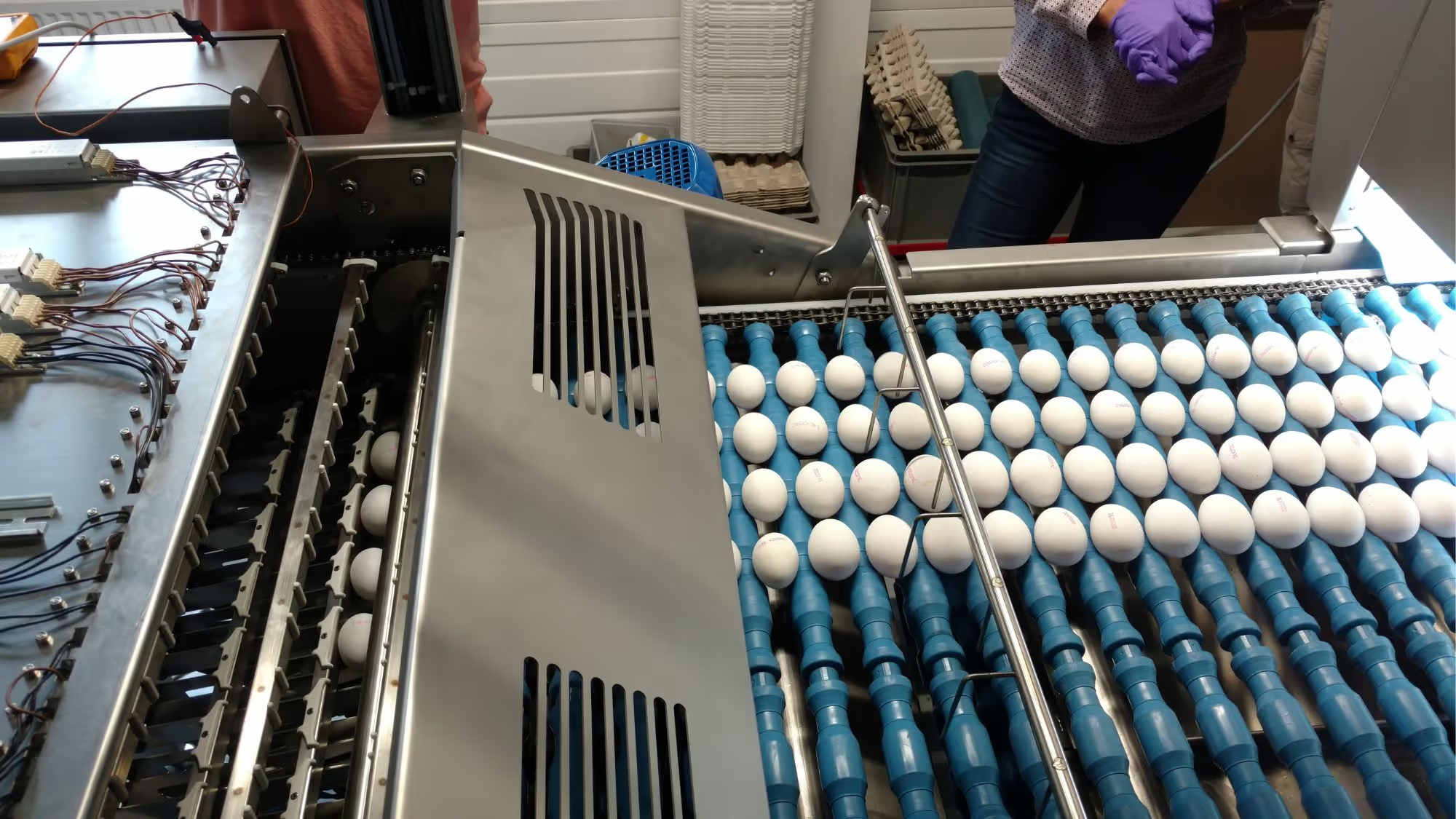
Batenburg Beenen is a specialist in the field of industrial automation and has over 100 years of experience. They are active in the food & beverage, mechanical engineering, chemical and infrastructure and water technology markets. Batenburg Beenen is developing a new machine. For the development of the machine they were looking for a party that can provide depth and support in the field of new technology and mechanical engineering.
On a collaborative level, Batenburg Beenen and QING set to work on realizing the machine. The experience that both companies have with innovating in agrifood is a great advantage for the project, according to Batenburg Beenen.
As the start of the innovation process, we started with an innovation session, this is part of the Development Roadmap. A Development Roadmap provides concrete insight into the complexity, costs and feasibility of the solution. The innovation session took place with a number of engineers from Batenburg Beenen and QING. During this session we challenge the issue and brainstorm on possible solutions, risks and challenges.
The innovation session was received positively by the Batenburg Beenen team. Thom Verwater, Head of R&D, said the following about it, "During the session we quickly got consensus on what we don't want or won't do. This was very valuable, this is how you create the right scope and bring focus. All possible solutions are discussed, which gives certainty. As a result, you don't think afterwards; wouldn't it have been better to test that other concept?".
Both teams already got to know each other well during the innovation session, which Thom says set the foundation for fine communication of the process.

Proof of Concept is an important part of QING's Agile Development approach. With Agile Development, we divide the project into sprints. With this approach, you keep a grip on progress and costs. You also avoid unforeseen risks, challenges and failure costs.
In innovation projects, we go back to basics and dissect the issue. Step by step, we look at what is needed for the most innovative and sustainable solution. We also did this for the Batenburg Beenen project. Each step was tested and validated per sprint; we call this Proof of Concept. This excludes possible risks and demonstrates feasibility.
With Proof of Concepts, assumptions are tested. According to Thom, the QING engineers leave nothing to chance and this is how we get closer and closer to the solution. In some cases this costs a lot of time and energy, but at the end of the day it saves time and money. By testing early on, you avoid unnecessary inconveniences later on in the process.
Another great advantage of working in sprints is that there is weekly contact between the engineers of QING and Batenburg Beenen. As a customer, you are always well informed of the progress and involved in every step that is taken.
Thom indicated that the great distance between the two companies is not a factor: "We have a fine communication with the engineers. During the weekly stand-up we get a detailed update''.
Wondering if our approach fits your issue? Then get in touch with us.

Will is happy to help you




.avif)